

What Is a Tech Pack? What Your Factory Actually Needs
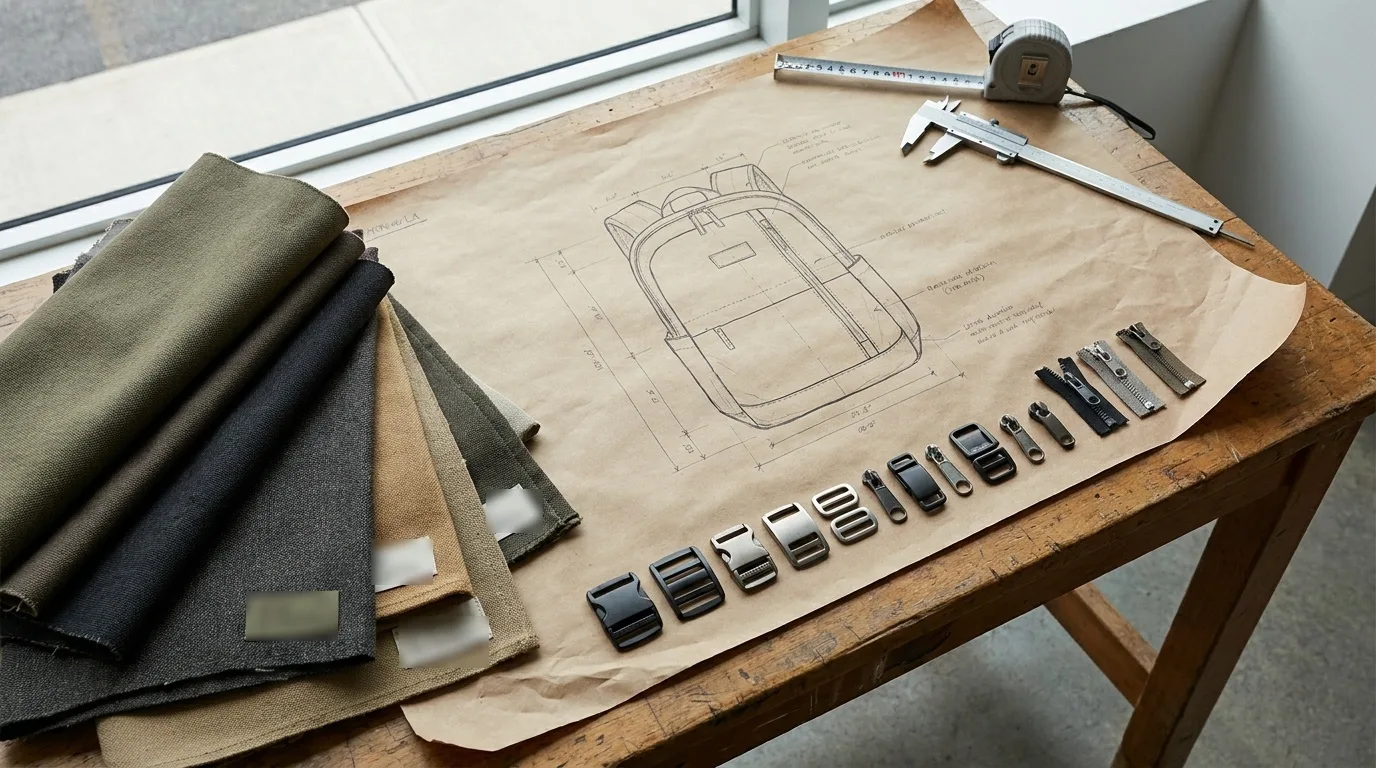
A tech pack is the document a factory quotes from, samples from, and builds from. It is the difference between a quote you can trust and a number someone invented to make you go away. This is what belongs in one, what happens on our floor when a pack is thin, and how to put a usable one together before you have hired anyone.
What a tech pack actually is
A tech pack is the complete written specification of one product. Every measurement, every material, every piece of hardware, every stitch type, and every label, collected in one document that travels with the order.
Think of it as the instruction set. A factory does not know what is in your head. We know what is on the page. If a detail is not written down, someone on the floor makes a decision about it, and that person is optimizing for what is fast and familiar on their line, not for what you pictured.
The name puts people off. It sounds like something only a real brand with a design department would have. It is not. A tech pack is just the answer to every question a factory would otherwise have to ask you, written down before they ask.
What goes in one
The specification drawing
Flat, front and back, drawn straight on rather than in perspective. Perspective looks better in a deck and is useless for building. Call out each panel and seam with a number so the rest of the document can refer to them.
You do not need CAD. A clean hand drawing that is dimensioned and labelled beats a beautiful render with no measurements.
The measurement chart
Every dimension that matters, with a tolerance on each. Height, width, depth, strap length, strap adjustment range, zipper opening, pocket depths. Tolerance is the part founders skip, and it is the part that decides whether a sample gets rejected. Say a strap is 800mm and it is 812mm, is that a fail? Only your tolerance answers that.
The bill of materials
Every material and component, by name and specification, not by adjective. Not “durable nylon” but the fabric, weight, coating, and colour. Not “strong buckle” but the size, the maker, and the finish. List the hardware, thread, webbing, zippers, sliders, labels, hang tags, and packaging.
This is where costs live. A bill of materials is what lets a factory price your product instead of guessing at it.
Construction details
How the pieces go together. Seam types, stitch counts, bar tacks and where they go, reinforcement at stress points, binding, edge finishes, and which seams are sealed. On a technical bag this section is often longer than everything else, and it should be.
Labels, packaging, and marking
Where the main label sits, what the care label says, whether there is a hang tag, how each unit is bagged, how many go in a carton. Left out of the pack, these get decided in the last week of production, which is the worst possible time.
What a thin tech pack costs you
Here is what happens on our side when a pack arrives half finished.
- The quote goes up. Unknowns are risk, and risk gets priced in. A factory quoting a vague spec pads it, because they will be the ones eating the difference when the assumptions turn out wrong.
- The sample comes back wrong. Not because anyone ignored you. Because a gap got filled by whoever hit it first, using the construction they already know.
- Rounds multiply. Each sample round on soft goods is weeks, not days, once you count shipping both ways. Two avoidable rounds can push a launch a full season.
- Comparing quotes stops meaning anything. Send a thin pack to four factories and you get four different products priced four different ways. The cheapest number is usually the one that assumed the least.
The pattern I see most: a founder spends months on the idea and an afternoon on the spec, then judges factories on the quotes that spec produced.
You do not need a designer to start
Version one of your tech pack can be a document you write yourself. Photograph a product you own that is close to what you want. Measure it with a tape and a caliper. Write down every dimension. Cut a piece off a fabric you like and staple it to the page. Name the buckle you want by its actual maker and size.
That document is enough to have a real conversation. A factory can read it, ask three sharp questions instead of thirty vague ones, and quote it. Most factories that do development work, ours included, will help you turn that into a proper pack, because a good pack makes our job easier too.
What you should not do is send a Pinterest board and ask for pricing. That is not a brief. It is a mood, and nobody can build a mood.
If you want a starting point, work through the sections above in order and fill in what you know. The gaps that remain are exactly the list of questions to bring to your first factory call. That list is more useful than a template you found and did not understand.
What to do this week
Pick the product you actually intend to make and write its measurement chart. Just that one section, on paper, in an hour. It will be uncomfortable, because it forces decisions you have been deferring, and that discomfort is the entire point: every decision you make now is one that will not be made for you on a factory floor in another country.
Once it exists, the rest of the pack is filling in around a spine that already holds. If you want someone to look at what you have written and tell you what is missing before you send it out, show me the product you are trying to make.